The educational uses for technology are endless! Smart boards allow teachers to project group exercises, which prevents students from sitting around bored while one section works with the teacher (see Classroom Management). If a potential exercise presents itself mid-lesson, the teacher can even draw the exercise right on the board, which allows for flexibility in the lesson. Finale, Sibelius, and other notation software allows teachers to write and arrange unique parts for their bands, which can help in making group activities, altering parts for differentiation, or even re-scoring entire works to fit a strange instrumentation. Online grade books are convenient for teachers, students, and parents alike, allowing for quick entry and editing and online home access to students progress. Online curriculum resources, such as Quaver Music, provide interactive music games for elementary students, and subscription services like Music K-8 provide chorus teachers with new, age-appropriate music, including sheet music, lyric pages, and mp3 backtracks for students to sing along with. The Harmony Director, a band director’s dream tool, acts as a metronome, piano, and tuner all in one, and can be adjusted to either just or equal temperament to teach advanced students the finer details of intonation and blend.
However, it is important to design lessons to be approachable without technology, because that technology sometimes fails us. When designing a lesson plan, teachers should always have a plan B that teaches the same concepts, in a similar way, without online or electronic resources. The internet may go down, or the smart board may short out, but the kids will still be there and wanting to sing and play. The show must go on! To that end, it is usually best to plan lessons that are assisted by technology, rather than dependent on them.
Below are some examples of the use of technology in the classroom.
Play Accompaniment (Percussion)
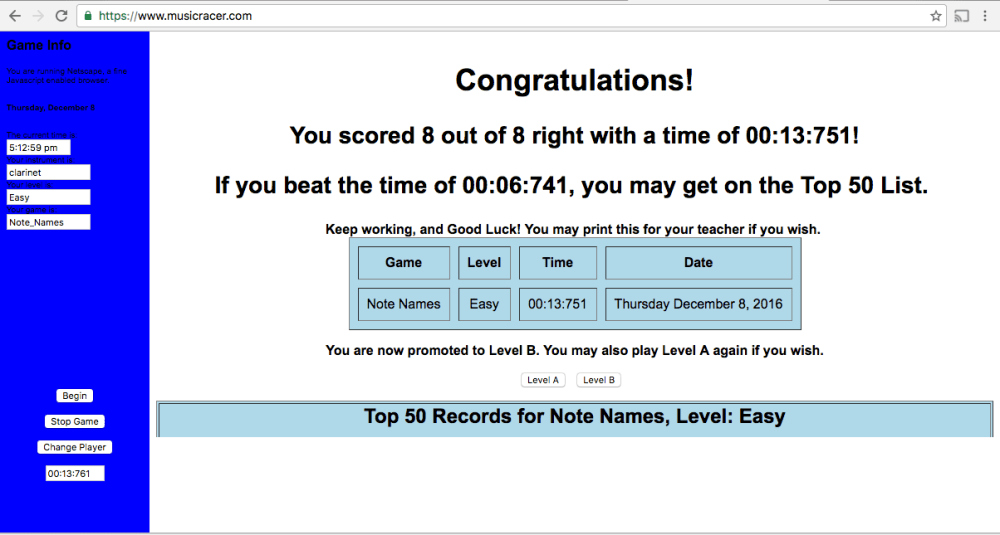
Music Racer, and online note-reading game. This is well used as an end-of class activity, to keep students engaged between packing up and leaving the room:
 Jonathan Hilgendorf